Guide 01 Family history research independent information
How to start a family tree
A family tree grows best from the present backwards. This guide gives a calm, repeatable method for beginners: what to write down first, who to ask, which papers to look for and how to keep the work trustworthy as it grows.
Begin with yourself and work backwards
Start with the person you know best: you. Write your full name, your date and place of birth, and the same details for your parents. Then add each grandparent. Only move to the next generation when the current one is as complete as you can make it.
Working from the known to the unknown is the single rule that prevents most beginner errors. It is tempting to jump to a famous surname or an old family story and try to connect it downward. That approach usually produces a tree that looks impressive and is wrong. A tree built one generation at a time stays honest.
Ask the people who remember
Living relatives are your most perishable source. Talk to the oldest ones first, and do it soon. Ask open questions: where did you grow up, who lived in the house, what did people do for work, who moved away and why. Names, places and approximate years matter more than polished stories.
Record the conversation if the person agrees, or take notes the same day. Write down the name of the person who told you each thing and the date. Family memory is valuable evidence, but it is memory: nicknames replace given names, dates drift and two people can remember the same event differently.
Collect the papers already at home
Before you search anywhere else, look through what the family already holds: birth, marriage and death certificates, school and military papers, old letters, photographs with names on the back, family bibles, funeral cards and address books. Each document can hold a date, a place or a maiden name that opens the next search.
Photograph or scan every item and keep the original safe and dry. Label each file with the name, the kind of document and the year. A folder of clearly named scans is a better foundation than a pile of loose paper.
Start a family tree on paper, on a chart or in free software
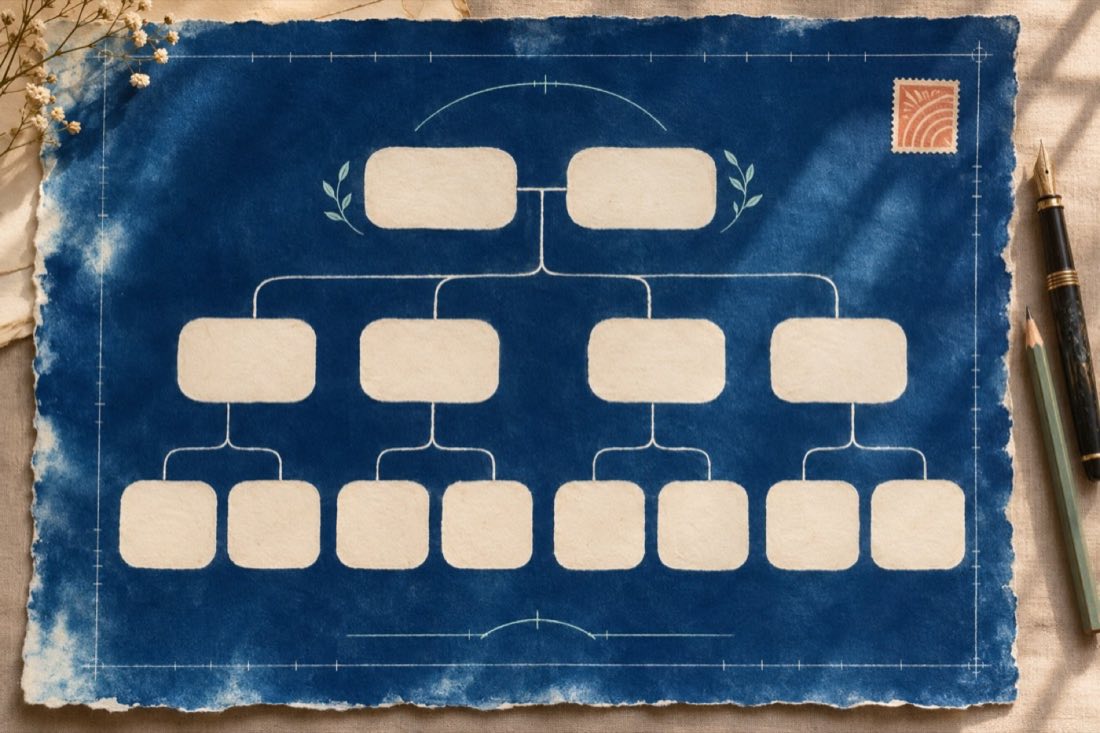
A pedigree chart is a simple diagram: you at the left or bottom, parents behind you, grandparents behind them. Beginners often use the Ahnentafel numbering system, in which you are number 1, your father is 2 and your mother is 3. For any person numbered n, the father is 2n and the mother is 2n plus 1. It sounds technical, but it makes any chart easy to read and to check.
You can keep a chart on paper, in a spreadsheet or in free family tree software. Pick one place for the master copy and stay with it. Several half-finished trees in different programs lead to the same ancestors being entered twice with different dates.
You can start a family tree for free. A sheet of paper and a pencil are enough for the first three generations, and free software or a spreadsheet can take over when the chart grows.
Keep a research log and cite every fact
Genealogists use a standard called the Genealogical Proof Standard. In short, it asks for a reasonably exhaustive search, a complete and accurate source citation for every fact, careful analysis of the evidence, resolution of any conflicts between sources and a clear written conclusion. You do not need to master it on day one, but the habit of noting a source for each claim is worth learning immediately.
A simple note such as the record type, the place, the date you looked at it and where you found it is enough to begin with. When two sources disagree, keep both and record the disagreement instead of choosing the answer you prefer.
A research log is a simple table with the date, the source you searched, what you were looking for and what you found, including when you found nothing. It stops you repeating the same search twice and shows where the gaps are.
Common beginner mistakes
Copying other people's online trees without checking them is the most common one: an error entered once is soon repeated across many trees. Treat an online tree as a hint that tells you where to look, not as proof.
Assuming that people with the same name are the same person is the second. Many towns had several men with the same name living at the same time. Look for a second detail, such as a spouse, an occupation or an address, before you join two records. When you are ready to look beyond the family, birth, marriage and death records and census records are the next two steps.